
Quick Answer: Myofunctional therapy in Malaysia can costs RM100-300 per session in Penang, Malaysia. Suitable for children age 4+ with mouth breathing, snoring, or tongue thrust, and adults with orthodontic relapse as well.
Consultation Available
- 📞 WhatsApp: +6011-2841-4919
- 📍 Location: 1-03-3A Jalan Sungai Tiram 8, Summerskye Residences, Bayan Lepas, Penang
- 📷 Instagram: @skydental.pg
- ⏰ Hours: Mon-Sun 10am-7pm | Tue-Thu 10am-8pm
Not sure if your child needs myofunctional therapy? Book an consultation with Dr. Felicia via WhatsApp
Why Myofunctional Therapy Matters in Malaysia
What is myofunctional therapy?
Myofunctional therapy is neuromuscular re‑education of the oral and facial muscles, focusing on tongue posture, lip seal, and proper nasal breathing. Structured exercises teach patients to keep the tongue on the palate, breathe through the nose, and coordinate chewing and swallowing more efficiently. It supports better jaw development, airway function, and long‑term stability of orthodontic treatment.
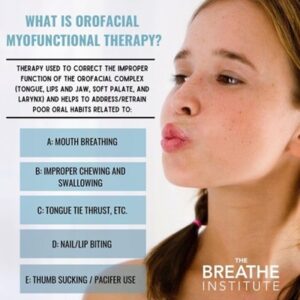
image credit
What are the benefits of Myofunctional Therapy ?
1)Impact on breathing and sleep
By strengthening upper airway and orofacial muscles, myofunctional therapy promotes nasal breathing and helps reduce mouth breathing and snoring. In obstructive sleep apnea, studies show therapy can cut the apnea‑hypopnea index roughly in half in adults and by about 60% in children, with better oxygen levels and less daytime sleepiness.
2)Role in craniofacial growth and orthodontics
In children, correcting tongue thrust and open‑mouth posture supports healthier craniofacial growth and airway development, and may reduce problems like bedwetting and night terrors linked to sleep‑disordered breathing. Myofunctional therapy also improves dental occlusion and helps decrease open bite and overjet, acting as an important adjunct to orthodontics and lowering the risk of relapse.
3)Benefits for speech, swallowing, and oral function
Improved tongue posture and strength enhance articulation and speech clarity, especially in patients with lisps or other orofacial myofunctional disorders. Therapy refines swallowing patterns, reduces tongue thrust and gag reflex sensitivity, and improves overall chewing and oral motor control, making eating safer and more comfortable.
4)Whole‑body and quality‑of‑life gains
Better sleep and oxygenation are associated with improvements in behavior, attention, school performance in children, and reduced cardiovascular risk factors in adults. Because it is non‑invasive and exercise‑based, myofunctional therapy offers a low‑risk way to enhance outcomes of dental, orthodontic, airway, and speech interventions while improving long‑term health and quality of life
Myofunctional therapy is a conservative way to improve function so that aesthetic and orthodontic results are more stable and health‑based.
Schedule a consultation with our doctor at Skye Dental today! Explore the option for your unique needs, bringing you one step closer to achieving your dream smile.
Common Signs You May Need Myofunctional Therapy
In Children
- Habitual mouth breathing or sleeping with the mouth open
- Snoring, restless sleep, or frequent waking at night
- Dark eye circles, open‑mouth posture during the day
- Difficulty chewing properly or very picky eating
- Forward head posture or “tired face” appearance
In Teenagers and Adults
- Snoring or possible sleep apnea symptoms
- Jaw joint clicking, clenching, or morning headaches
- Relapse after previous orthodontic treatment
- Difficulty keeping lips closed at rest
- Tongue thrust when swallowing or lisping speech
If several of these are present, an airway‑focused assessment and myofunctional evaluation is often recommended.
How Myofunctional Therapy Works
Myofunctional therapy is usually delivered as a series of guided sessions, often once every 2–4 weeks, supported by daily at‑home exercises. A typical program aims to:
- Train nasal breathing instead of mouth breathing
- Establish correct tongue resting posture on the palate
- Correct swallowing patterns to eliminate tongue thrust
- Strengthen and coordinate lip and facial muscles
- Support better head and neck posture
Most programs run for around 3–9 months depending on the age of the patient, previous orthodontic treatment, and severity of habits.
Myofunctional Therapy vs Myobrace vs Braces: Which Is Best?
Many parents ask: “Should I choose myofunctional therapy, Myobrace, or traditional braces for my child?” Here’s the honest comparison:
| Factor | Myofunctional Therapy | Myobrace | Traditional Braces |
|---|---|---|---|
| Cost in Malaysia | RM100-RM200 / session | RM800- RM3600 / treatment | RM4000-8000 |
| Treatment Duration | 3-9 months | 9 -18 months | 18-36 months |
| Best Age | 4 years+ (ideal: 5-10) | 5-12 years | 10+ years |
| Main Focus | Fix breathing & tongue habits | Jaw growth + habit correction | Straighten teeth only |
| Requires Appliances | No (exercises only) | Yes (removable device) | Yes (fixed brackets) |
| Daily Commitment | 10-15 min exercises 2x/day | Wear 12-14 hours daily | None (always on) |
| Pain/Discomfort | None | Mild adjustment period | Moderate soreness |
| Prevents Relapse | ✅ Yes (fixes root cause) | ✅ Yes | ❌ High relapse risk without habits fixed |
| Can Combine With Others | ✅ Works with all treatments | ✅ Often paired together | ✅ Better results with myofunctional |
Myofunctional Therapy + Myobrace Is The recommended for Growing Children. Myofunctional therapy and Myobrace are designed to work TOGETHER to archieve a better result.
Here’s why this combination is so powerful for children aged 5-12:
The Problem with Myobrace Alone: Myobrace appliances guide jaw growth and straighten teeth mechanically. However, if your child continues mouth breathing, tongue thrusting, or poor lip posture while wearing the device, the appliance fights against bad habits constantly. It’s like trying to build a house while someone keeps knocking down the walls.
The Problem with Myofunctional Therapy Alone: Myofunctional exercises correct breathing and tongue habits beautifully. But for children who already have narrow jaws, crowded teeth, or developing bite issues, exercises alone can’t physically expand the jaw or move teeth into position. The habits are fixed, but the structural damage remains.
Schedule a consultation with our doctor at Skye Dental today! Explore the option for your unique needs, bringing you one step closer to achieving your dream smile.

FAQ About Myofunctional Therapy
1)Q: How long does myofunctional therapy take to see results?
A: Most patients notice initial improvements within 4-6 weeks:
Full program typically takes 6-8 months for children, 9-12 months for adults. However, every case is individual – some see dramatic results faster, others need more time.
2)Q: Can adults benefit from myofunctional therapy?
A: Absolutely! Adults benefit in some of the situation below :
- TMJ pain or jaw clicking
- Snoring or sleep apnea
- Orthodontic relapse after braces
- Chronic mouth breathing
- Tongue thrust affecting speech
3)Q: Is myofunctional therapy painful?
A: No! There’s absolutely no pain. It’s gentle exercises similar to stretching or physiotherapy. Children find the exercises easy and often fun (we make it game-like). The only “discomfort” is the initial awkwardness of doing new movements, like learning to ride a bicycle. Within 1-2 weeks, exercises become natural.
4)Q: How is myofunctional therapy different from speech therapy?
A: Great question – they’re related but different:
| Aspect | Speech Therapy Focus | Myofunctional Therapy Focus | Overlap / Example Use |
|---|---|---|---|
| Primary goal | Improve pronunciation, language, and communication skills | Correct oral posture, breathing, swallowing, and muscle use | Both may be used when muscle patterns affect speech clarity |
| Key targets | Pronunciation of sounds; articulation problems | Tongue resting posture; jaw and facial muscle coordination | Tongue thrust or low tongue posture can contribute to speech sound errors |
| Breathing | Not the main focus | Optimising nasal vs mouth breathing pattern | Mouth breathing patterns may indirectly influence speech and oral function |
| Swallowing | Addressed only if it affects speech or feeding | Core focus: swallowing mechanics and tongue movement | Tongue thrust swallow can require both functional retraining and speech correction |
| Typical example | Child with a lisp due to motor speech patterns | Child with tongue thrust affecting teeth and airway | Child with lisp caused by tongue thrust benefits from both therapies simultaneously |
Speech Therapy Focus:
- Pronunciation of sounds
- Language development
- Communication skills
- Articulation problems
Myofunctional Therapy Focus:
- Tongue resting posture
- Breathing pattern (nose vs mouth)
- Swallowing mechanics
- Jaw muscle function
- Facial muscle coordination
The Overlap: Sometimes tongue thrust or low tongue posture CAUSES speech issues. In these cases, we often recommend BOTH therapies.
Example: Child with lisp (speech issue) caused by tongue thrust (myofunctional issue) benefits from both therapies running simultaneously.
5) Q: Why is myofunctional therapy more affordable than Myobrace or braces?
A: Myofunctional therapy costs less because:
- No appliances needed (just exercises)
- No lab fees for removable devices
However, combining myofunctional therapy WITH Myobrace or braces often gives best long-term results. Think of it as: Myofunctional therapy = fixing the ROOT CAUSE. Braces/Myobrace = fixing the RESULT of bad habits.
6)Q: What if my child has allergies or chronic sinus issues?
A: Allergies and sinus issues often CO-EXIST with mouth breathing, but don’t prevent myofunctional therapy.
Our Approach:
- Address allergies with pediatrician/ENT specialist
- Start myofunctional therapy once allergies are managed (doesn’t need to be perfect, just manageable)
- Nasal saline rinses daily to keep airways clear
- Progress may be slower initially, but still effective
7)Q: Can myofunctional therapy cure sleep apnea?
A: Myofunctional therapy doesn’t “cure” sleep apnea, but it significantly HELPS:
Research Evidence:
- Reduces sleep apnea severity by 30-50%
- Decreases snoring frequency and volume
- Improves
8)Q: Why can myofunctional therapy “fail” in some patients?
A: Myofunctional therapy often fails when exercises are not done correctly or consistently, because progress depends on daily, precise muscle training over months. Outcomes are also limited if underlying issues such as severe skeletal discrepancies, enlarged tonsils, or uncontrolled nasal obstruction are not addressed alongside therapy.
9)Q:What level of compliance is realistically needed for results?
A: Most protocols expect 5–10 minutes of exercises per day, at least 5 days a week, for 3–6 months, sometimes longer. Real‑world studies show adherence can be as low as about 10% without strong follow‑up or digital tools, so patients must be prepared for a “physiotherapy‑style” commitment rather than a quick fix.
10)Q:Who is generally suitable for myofunctional therapy?
A: It tends to work best for motivated children, teens, and adults who can follow instructions, attend reviews, and have treatable habits like mouth breathing, tongue thrust, or low tongue posture contributing to mild‑to‑moderate problems. It is especially useful as an adjunct in orthodontics, airway/sleep dentistry, and CPAP or MAD use, where improved muscle tone and function can enhance and stabilise other treatments.
11)Q: Who may not be good candidates or need something else first?
A: Patients with significant cognitive, behavioural, or physical limitations that prevent them from understanding or performing exercises independently may not benefit, unless a caregiver can reliably assist. Those with major skeletal discrepancies, certain Class III patterns, severe TMJ restriction, or craniofacial syndromes often need surgical, orthodontic, or medical management first, with myofunctional therapy only as a secondary support if appropriate.
12:Q: What are the “hard truths” about myofunctional therapy that patients should know?
A: Therapy demands high effort and behavioural change, and results can regress if habits return, so it is not a magic cure or a replacement for necessary surgery, orthodontics, or medical treatment when those are clearly indicated
Why Choose Skye Dental for Myofunctional Therapy:
✅ Dr. Felicia Chai’s Training:
- Bachelor of Dental Surgery, AIMST University
- Children friendly and airway dentistry
- Author of children’s dental books: “The Secret of Tooth Fairy Land” & “How to Fight Tooth Bugs”
✅ Integrated Approach:
- Myofunctional therapy combined with orthodontics when needed
- Coordinates with ENT specialists, speech therapists
- One-stop solution: Assessment → Treatment → Follow-up
✅ Children-Friendly Environment:
- Dedicated play area keeps kids comfortable
- Focus in gentle, fear-free approach
✅ Flexible Scheduling:
- Evening appointments available (until 8pm Tue/Thu)
- Weekend slots available
- WhatsApp reminders and support
- Virtual follow-up options when appropriate
Looking for “Myofunctional Therapy Near Me” in Penang, Malaysia?
If you’re searching “myofunctional therapy near me”, “children breathing therapy Penang”, or “tongue therapy for kids”, you’ve found the right place.
Skye Dental is dedicated myofunctional therapy provider in Bayan Lepas with a dentist in airway-focused treatment for both children and adults.
Why Location Matters:
Convenience for Regular Sessions:
- Myofunctional therapy requires 8-10 visits over 6-9 months
- Being close to home/work means better compliance
- Evening/weekend slots accommodate working parents
Local Community Trust:
- Established in Bayan Lepas since 2018
- 150+ families from surrounding neighborhoods
- Strong relationships with local pediatricians, ENT specialists
Free Parking = Stress-Free Visits:
- Georgetown clinics often have parking issues
- Skye Dental offers FREE parking always
- Easy access for parents with multiple children
How to Book Myofunctional Therapy at Skye Dental
3 Easy Ways to Book:
Method 1: WhatsApp (Fastest – Recommended)
- Save number: +6011-2841-4919
- Send message: “Hi, interested in myofunctional therapy assessment for [child’s name, age]”
- Include: Brief description of concerns (snoring, mouth breathing, etc.)
Method 2: Phone Call
Call: 04-286-9399 (clinic hours: 10am-7pm Mon-Sun, until 8pm Tue-Thu)
Our receptionist will:
- Book your assessment appointment
- Send WhatsApp confirmation
- Answer basic questions
Method 3: Instagram DM
Message: @skydental.pg Good for: Viewing before/after cases, asking quick questions
Not ideal for: Booking appointments (slower response than WhatsApp)
Author