

If your child’s dentist has mentioned a “root canal” for a badly decayed tooth, it’s natural to have a lot of questions — and some worry. At Skye Dental Clinic Penang, we get asked about root canal treatment for kids often, so we’ve put together this complete guide covering what it actually involves, why cooperation matters more than you might expect, and what your realistic options are.
1. What is a root canal treatment for kids (pulpotomy or pulpectomy)?
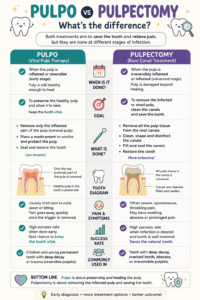
In children, what’s commonly called a “root canal” is usually either a pulpotomy (removing only the infected upper part of the nerve) or a pulpectomy (removing the entire nerve, closer to an adult root canal). Both aim to save a badly decayed or infected tooth rather than extracting it, and both are treatments our dental clinic in Penang performs regularly.
| Aspect | 🦷 Pulpotomy (PULPO) | 🦷 Pulpectomy |
|---|---|---|
| What is it? | Removes the affected pulp from the crown of the baby tooth while keeping the healthy pulp in the roots | Removes the entire pulp, including the pulp inside the root canals |
| When is i needed? | Usually when decay is very deep and has reached the pulp, but the root pulp is still healthy enough to preserve | Usually when the pulp is severely infected, inflamed, or dead and cannot be preserved |
| How much pulp is removed? | Only the affected part of the pulp | The whole pulp from both the crown and roots |
| Root canals | The root canals are not completely cleaned and filled | The root canals are cleaned and filled with a material suitable for baby teeth |
| Common signs | Deep cavity or pulp exposure, but without significant signs of infection around the roots | May involve toothache, swelling, abscess, pus, or infection around the roots |
| Main goal | To preserve the healthy root pulp and keep the baby tooth functioning | To remove the infection and save the baby tooth |
| Treatment complexity | Generally a simpler procedure | Generally a more extensive procedure |
| After treatment | The tooth is usually restored with a filling or stainless-steel crown, depending on the amount of tooth structure remaining | The tooth is usually restored with a stainless-steel crown to protect it |
2. Why would a child need a pulpotomy or pulpectomy instead of just a filling?
This is needed when decay has reached deep enough to affect the tooth’s nerve. A regular filling only addresses the outer part of a cavity — once the nerve is infected or inflamed, a filling alone won’t resolve the pain or infection.
3. Do baby teeth need root canal treatment , since they’ll fall out eventually?
Yes — an infected baby tooth can cause significant pain that affects your child’s ability to eat and sleep comfortably, and the infection can recur or worsen if left untreated. Baby teeth also hold space for adult teeth, so saving them (rather than early extraction) matters for proper alignment later.
4. What are the signs my child might need a pulpotomy or pulpectomy?
Common signs include persistent tooth pain (especially at night), swelling of the gum near a tooth, a visible dark spot or hole with deep decay, sensitivity that lingers after eating, or a small bump on the gum (an abscess).
5. Does a pulpotomy or pulpectomy require an injection?
Yes — unlike SDF, which needs no injection at all, a pulpotomy or pulpectomy requires local anaesthesia (an injection) to numb the area before treatment, since the procedure involves removing infected nerve tissue. This is an important difference to know when weighing root canal treatment options for an anxious child.
6. Can my child still haveroot canal treatment , if they’re scared or won’t cooperate?
It depends on the child. Because this procedure requires an injection and the child needs to stay still for a meaningful period, a good level of cooperation is genuinely necessary — this isn’t a quick, no-anaesthesia treatment like SDF. We’ll always try gentle behavior-guidance techniques first, but if a child is too frightened or unable to stay still, we may not be able to safely complete the procedure in a regular dental clinic consultation-room setting.
7. What happens if my child cannot cooperate at all for the procedure?
If cooperation isn’t possible even with behavior guidance or nitrous oxide sedation, we’ll discuss alternatives — this may include referral for treatment under general anaesthesia, or in some cases, using SDF as an interim measure to manage the infection while a longer-term plan is made. Your child’s comfort and safety always come before pushing through a procedure they’re not ready for.
8. How long does a pulpotomy or pulpectomy take for a child, and how many visits?
A single sitting typically takes around 30–45 minutes, though the full treatment often isn’t completed in one visit. Depending on the tooth involved and how the child copes, root canal treatment for kids may take 2–3 visits to complete — for example, one visit to remove the infection, and follow-up visits to finish the procedure and place a protective crown.
9. Is sedation used for children’s pulpotomy or pulpectomy treatment?
For children who are anxious but can still cooperate with guidance, we may use nitrous oxide sedation alongside the required local anaesthesia injection. For children who cannot cooperate even with sedation support, referral for treatment under general anaesthesia may be recommended instead.
10. How do I know if my child needs a filling, SDF, or a pulpotomy/pulpectomy?
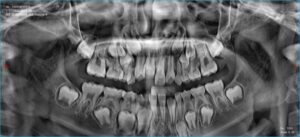
This depends on how deep the decay has progressed. Early-stage cavities may only need SDF or a filling, while decay that has reached the nerve requires a pulpotomy or pulpectomy to resolve the infection. Our dentist at Skye Dental Penang will assess this with an exam and, if needed, an X-ray.
11. Can root canal treatment for kids fail, and what happens if it does?
Yes, in some cases the treated tooth can develop a new infection or fail to heal properly, especially if decay was extensive. If this happens, the next step is usually extraction of the tooth, since re-treating a baby tooth is often not practical.
12. How should I care for my child’s tooth after root canal treatment treatment?
Avoid hard or sticky foods on that tooth for the first day or two, maintain regular brushing, and keep up with follow-up visits so we can monitor healing and place a protective crown if needed.
13. What happens after treatment — does the tooth need a crown?
Yes, in most cases. After a pulpotomy or pulpectomy, the tooth is significantly weakened and prone to breaking, so it’s usually capped with a stainless steel crown (SSC) to protect it and allow your child to bite and chew normally until the tooth naturally falls out. See our full guide on stainless steel crowns for kids →
14. Can a pulpotomy or pulpectomy be avoided if caught early enough?
Yes — this is exactly why early checkups and prompt treatment of small cavities matter. Catching decay before it reaches the nerve means a simple filling or SDF may be enough, avoiding the need for a more involved procedure altogether. For children with a high caries rate (frequent, multiple cavities), a stainless steel crown (SSC) may also be recommended proactively on at-risk teeth, even before a full pulpotomy or pulpectomy is needed, as a way to protect weaker teeth from progressing to that stage.
15. How much does pulpotomy or pulpectomy treatment cost for a child at Skye Dental Penang?
Costs vary depending on which procedure is needed but generallly range from RM250 and above. Also whether a crown is required afterward. We recommend starting with a consultation, which costs RM20–RM50, so our dentist can assess the tooth at our Penang dental clinic and give you an accurate treatment quote.
Worried about your child needing a root canal?
Every child’s situation is different, and cooperation plays a bigger role in root canal treatment for kids than most parents expect. Our dentist at Skye Dental Clinic Penang will walk you through what’s realistic for your child — whether that’s a pulpotomy, pulpectomy, SDF, or a referral. Contact us / Book a consultation