
If your child has a cavity but won’t sit still, won’t open their mouth, or gets distressed at the thought of dental treatment, you’re not alone — and kids cavity treatment in Penang has more options than “wait it out” or “force it.” At Skye Dental Penang, we regularly help parents navigate this exact situation using a mix of gentle behavior guidance, Silver Diamine Fluoride (SDF), and sedation options tailored to each child.
Here’s a full breakdown of what causes cavities (dental caries), why kids resist treatment, and what your realistic kids cavity treatment options are in Penang.
1. What causes cavities (dental caries) in children?
Cavities, medically known as dental caries, form when bacteria in the mouth feed on sugars and produce acid that gradually breaks down tooth enamel. In children, this often happens faster due to frequent snacking, bottle-feeding at night, or inconsistent brushing.
2. Why won’t my child cooperate for a cavity filling?
Young children may resist dental caries treatment due to fear of the unknown, discomfort with lying still, sensitivity to sounds and sensations, or simply not being developmentally ready to sit through a procedure. Past traumatic experiences — such as a recent hospitalisation, surgery, or a previous difficult medical visit — can also make a child more fearful or resistant, even if it wasn’t dental-related.
3. What are the kids cavity treatment options in Penang for an uncooperative child?
Depending on the case, kids cavity treatment options at Skye Dental Penang include behavior-guidance techniques over multiple short visits, Silver Diamine Fluoride (SDF) to halt dental caries without drilling, nitrous oxide sedation to help the child relax, or referral for general anaesthesia in more complex cases.
4. What is Silver Diamine Fluoride (SDF) and how does it treat dental caries?
SDF is a liquid medicine painted directly onto a cavity to stop the caries from progressing further. It’s applied in seconds with no drilling, injections, or anesthesia needed, making it especially useful for young or anxious children.
5. Is SDF a good option instead of a filling for an uncooperative child?
Yes, SDF is often a practical first step for children who aren’t ready for a filling. It stops the cavity from worsening and buys time until the child is older or more cooperative, though it may need to be followed by a filling later depending on the tooth.
6. What are the downsides of using SDF instead of a regular filling?
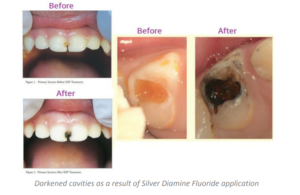
The main downside is cosmetic — SDF permanently turns the treated part of the cavity black. It also doesn’t rebuild lost tooth structure or close up the cavity itself, so food and other substances can still get stuck in the treated area, meaning it’s typically used as a decay-control measure rather than a permanent restoration.
7. How often does SDF need to be applied or reapplied?
SDF is usually reapplied every 6 months, or as advised by your dentist, to keep the dental caries arrested. Your dentist at Skye Dental Penang will monitor the tooth at regular checkups and decide whether reapplication or a follow-up filling is needed.
8. What sedation options are available for children who can’t cooperate for dental treatment in Penang?
Skye Dental Penang offers nitrous oxide (laughing gas) sedation in-house for children who need extra help staying calm during treatment. For more complex cases requiring general anaesthesia, we refer out to the appropriate specialist facility.
9. Is nitrous oxide (laughing gas) safe for kids?
Yes, nitrous oxide is widely regarded as one of the safest sedation options for children. It’s mild, wears off quickly after the mask is removed, and the child remains conscious and responsive throughout treatment. This aligns with the American Academy of Pediatric Dentistry’s guideline on nitrous oxide use in pediatric patients.
10. Does nitrous oxide always work? What are the indications and contraindications?
No, it doesn’t work for every child — nitrous oxide works best for mild to moderate anxiety in children who can still breathe comfortably through their nose and follow basic instructions. It’s generally not suitable for children with nasal blockage or a cold, certain respiratory conditions, or those with more severe anxiety or behavioral needs, in which case oral sedation or general anaesthesia may be considered instead.

11. What’s the difference between nitrous oxide, oral sedation, and general anaesthesia for kids?
Nitrous oxide is a light, inhaled sedation where the child stays awake and alert. Oral sedation uses medication to induce a deeper, drowsy state. General anaesthesia puts the child fully asleep and is reserved for extensive treatment or children who cannot cooperate even with lighter sedation — this is typically done via referral to a hospital or specialist setting.
12. When would general anaesthesia be recommended for a child’s cavity treatment?
General anaesthesia is usually considered when a child has extensive dental caries needing treatment, cannot cooperate even with nitrous oxide, has certain medical or developmental conditions, or is very young and needs multiple procedures done at once. In these cases, Skye Dental Penang will refer you to a suitable facility for GA treatment.
13. Is sedation dentistry safe for young children?
When administered appropriately and monitored by trained professionals, sedation methods like nitrous oxide are considered safe for children. That said, nitrous oxide isn’t suitable for every child — it works best when the child is able to follow simple instructions and breathe in through the nasal mask. There are also medical contraindications: it typically cannot be used if your child has the flu, a blocked nose, or has had recent surgery, among other conditions. Your dentist will assess your child’s health history and ability to cooperate with the mask before recommending any sedation option.
14. How do I decide between SDF, sedation, or waiting, for my child’s cavity?
This depends on factors like the size and location of the cavity, your child’s age and anxiety level, and how urgently the dental caries needs treatment. Our dentist at Skye Dental Penang will walk you through the best option after an assessment.
15. What happens if my child’s cavities are left untreated because they won’t cooperate?
Untreated dental caries can worsen and reach the tooth’s nerve (the pulp) — once this happens, the damage is generally irreversible, and the tooth will need more invasive treatment such as a pulp treatment or extraction. A painful or infected tooth can also affect your child’s ability to eat and sleep comfortably, which is why earlier, less invasive options like SDF or sedation are worth considering before it progresses this far.
16. How much does cavity, sedation, or SDF treatment cost at Skye Dental Penang?
Costs vary depending on the treatment needed. We recommend starting with a consultation, which costs RM20–RM50, so our dentist can assess your child’s cavity and cooperation level and recommend the most suitable — and appropriately priced — kids cavity treatment option. If this will be your child’s very first dental visit, our guide to a baby’s first dental visit in Penang covers what to expect before you even get to this stage.
Not sure which option is right for your child in Penang?
Every child is different, and the right approach depends on their age, anxiety level, and how far the dental caries has progressed. Our dentist at Skye Dental Penang will assess your child and walk you through the best path forward — whether that’s SDF, nitrous oxide sedation, or a referral.